
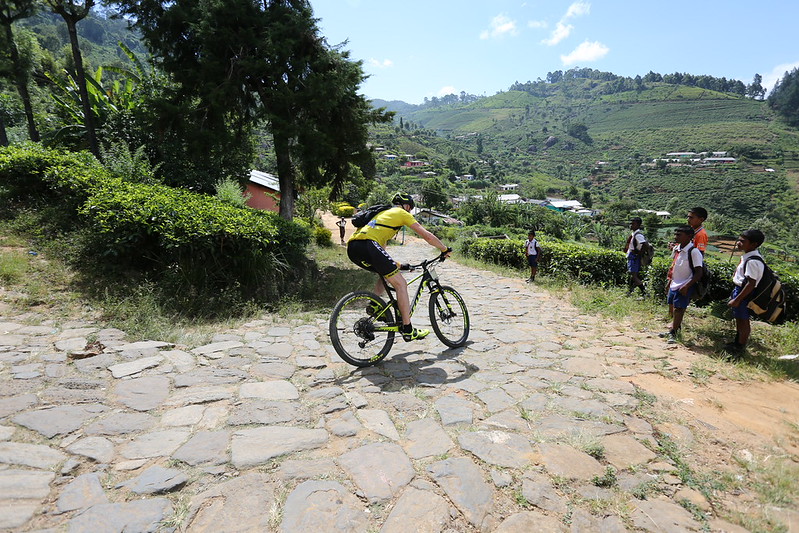

Sri Lanka rewards cyclists who are prepared to leave the obvious route behind. The best roads for cycling in Sri Lanka link misty tea estates, temple towns, dry-zone reservoirs and palm-fringed coasts in a compact island that feels far bigger from the saddle. One day can begin with a cool mountain climb and end with a spicy rice-and-curry lunch beside the Indian Ocean.
This is not a destination for chasing perfect tarmac or empty Alpine-style passes. It is a place for riders who enjoy texture: sweeping climbs through working tea country, rougher rural lanes, animated towns and encounters that turn a ride into a journey. Traffic, heat and monsoon patterns all demand respect, but choose your route and timing well and Sri Lanka delivers remarkably varied cycling.
Best roads for cycling in Sri Lanka: our standout routes
Kandy to Nuwara Eliya via Ramboda Pass
For a classic highland road day, the climb from Kandy towards Nuwara Eliya is hard to beat. The route steadily leaves the heat and bustle of the central province, rising through fruit stalls, forest, waterfalls and tea plantations. Ramboda Pass is the decisive feature: a long, sustained ascent rather than a single brutal ramp, with gradients that can feel serious once humidity and traffic are added to the equation.
The reward is the change in atmosphere. By the time you reach Nuwara Eliya, often called Little England for its colonial-era character and cool climate, the air is fresher and the landscape has become unmistakably highland. This is best suited to fit road riders and e-bike travellers comfortable with a full day of climbing. A support vehicle makes it far more enjoyable, particularly for those who want to stop for viewpoints, tea and photographs without worrying about carrying everything.
Nuwara Eliya to Ella through the tea country
If one road captures Sri Lanka’s cycling appeal, it is the highland journey south-east from Nuwara Eliya towards Ella. The terrain rolls and drops through tea estates, eucalyptus, villages and exposed viewpoints, with long sections of smooth, winding tarmac. There are plenty of climbing metres, but the profile is less relentlessly uphill than the Kandy approach.
Expect weather to be part of the experience. Morning mist can give way to bright sunshine, while afternoon rain is always possible in the hills. Descents may be wet, broken in places and shared with buses, tuk-tuks and lorries, so this is a route for measured riding rather than chasing speed. For gravel bikes, endurance road bikes and capable e-bikes, it is a genuinely memorable day.
Ella itself is busy compared with many hill-country villages, yet it earns its popularity. The views across the southern escarpment are spectacular, and a rest evening here gives riders time to appreciate how quickly the island’s landscapes have changed.
Ella to Wellawaya and the southern lowlands
The descent from Ella towards Wellawaya is one of Sri Lanka’s most exhilarating pieces of riding. Leaving the cooler uplands, the road tumbles through a dramatic transition of cloud forest, waterfalls and open valley. The descent is fast in places, but it should never be treated casually: bends tighten unexpectedly, surfaces vary and local traffic has its own rhythm.
Below Wellawaya, the riding becomes hotter, flatter and more open. This is where a multi-day route begins to feel especially satisfying. You have crossed from tea country into the dry-zone edge, where paddy fields, jungle and scattered temples replace the manicured hillsides. The contrast makes this a standout route for cyclists seeking a proper point-to-point journey rather than a collection of day rides.
Haputale, Bandarawela and the quiet estate roads
For riders who prefer quieter highland miles, the roads around Haputale and Bandarawela offer some of the island’s finest riding. These are not always the quickest lines between major towns, and that is precisely their appeal. Small estate roads and rolling connectors move through tea gardens and villages where daily life carries on at a gentler pace.
Haputale’s elevated position brings sweeping views when the cloud lifts, while Bandarawela makes a practical base for varied loop rides. Surface quality can be inconsistent and short ramps appear without warning, so a road bike with wider tyres – around 30mm if your frame allows – is a sensible choice. Strong gravel riders will also find plenty of rewarding detours, although route knowledge matters; a promising-looking lane can turn into rough concrete, loose stone or a steep dead end.
Sigiriya, Habarana and the ancient cities
The cultural triangle offers a completely different kind of cycling. Around Sigiriya, Habarana, Polonnaruwa and Dambulla, the roads are flatter and the days can be fiercely hot, but the riding opens up a landscape of reservoirs, forest and ancient civilisation. Early starts are essential. Set out at first light and you can ride through calm rural scenes before the temperature rises and traffic builds.
The route between Sigiriya and Polonnaruwa is particularly rewarding when incorporated into a wider journey. Long, straight stretches are broken by village life, monkeys in roadside trees and occasional glimpses of wildlife. Elephant movement is a genuine consideration in some forested areas, especially near national parks, so local guidance is not a luxury. It is a sensible part of riding responsibly here.
This region is ideal for cyclists who want history woven into the day rather than saved for a separate sightseeing excursion. A morning ride can finish at an extraordinary archaeological site, followed by a relaxed afternoon by the pool before the next stage.
The south coast from Tangalle to Mirissa
Sri Lanka’s south coast has the visual appeal many riders expect – coconut palms, fishing boats and bright blue water – but the main coastal road is often busy. The best riding comes from using it selectively, then slipping inland onto smaller roads through rice fields, cinnamon-growing areas and quiet village settlements.
A Tangalle-to-Mirissa day can be tailored to the group. Stronger riders may take rolling inland detours and longer distances; leisure-focused cyclists can keep the route more direct, arriving in time for a swim or a sunset drink. The heat and humidity are the main challenges, not elevation. Plan to ride early, carry more water than you think you need and accept that a proper lunch stop is part of the rhythm.
Choosing the right season and bike
Sri Lanka has two monsoon systems, so there is no single answer to the best time to ride everywhere. The central hills and south-west are generally most appealing from December to March, while the east and north tend to be drier from around May to September. Conditions can still vary sharply by altitude and coast, which is why a well-designed itinerary follows the weather rather than forcing one fixed route.
An endurance road bike is ideal where the itinerary focuses on major hill-country and coastal roads. A gravel bike offers more freedom on rural diversions and imperfect surfaces, while an e-bike can make the sustained central-highland climbs accessible without diluting the experience. Whatever you ride, use dependable gearing, good brakes and tyres capable of handling broken edges, gravel patches and tropical downpours.
What makes Sri Lanka different from a standard cycling holiday
The island’s roads are best enjoyed with patience and curiosity. Riders share space with tuk-tuks, buses, schoolchildren, dogs and occasionally cattle. Traffic can be assertive around towns, while the quieter roads demand attention for surface changes rather than vehicles. Confident handling and a willingness to ride adaptively matter more here than an obsession with average speed.
The logistical upside is substantial. Distances between radically different landscapes are short, and a supported itinerary can move luggage, manage transfers and keep the day focused on the riding. Local route knowledge also reveals the better alternatives to busy trunk roads and helps build in the stops that make the holiday: a tea estate, a roadside hopper breakfast, a temple visit or a cool hotel after a hard climb.
Multi Terrain Biking designs Sri Lanka journeys around exactly those details, pairing serious route planning with the local insight needed to make an ambitious ride feel stress-free. The finest road is rarely just the one with the best view. It is the one that arrives at the right place, at the right time, with enough left in the legs to enjoy what comes next.


