The first descent through Sri Lanka’s tea country tends to settle the question quickly. Red-earth tracks drop between clipped tea bushes, mist hangs over eucalyptus and pine, and a string of tight bends leads towards a village that rarely appears on a conventional holiday itinerary. So, is the hill country of Sri Lanka good for mountain biking? Absolutely – provided you arrive expecting a proper adventure rather than a purpose-built bike park.
This is riding with texture. The Hill Country rewards cyclists who enjoy long days, changing surfaces, punchy climbing and a real sense of place. It is not defined by lift-served trails, immaculate berms or trail-centre signage. Instead, it offers estate roads, forest tracks, old railway corridors, rough village lanes and quiet back roads that thread through one of Asia’s most dramatic highland landscapes.
Why Sri Lanka’s Hill Country works for mountain biking
The Hill Country has the ingredients that make a memorable mountain bike destination: elevation, variety, access to genuinely quiet terrain and scenery that changes mile by mile. Around Nuwara Eliya, Haputale, Bandarawela, Ella and Kandy, routes can move from cool tea estates to damp cloud forest, then fall away into warmer valleys in a single day.
The riding is especially strong for experienced recreational mountain bikers and gravel riders who are happy to mix surfaces. A typical route may start on tarmac, climb an estate lane, roll along hard-packed dirt beneath tea plantations, then descend a rocky double-track through forest. This constant change keeps the riding engaging without requiring every kilometre to be technical.
Altitude is another advantage. Much of the central highlands sits between roughly 1,000 and 2,000 metres, so mornings are often refreshingly cool compared with Sri Lanka’s coast. The altitude is noticeable on sustained climbs, particularly for riders arriving straight from sea level, but it is not usually high enough to become an acclimatisation issue. It simply adds a little bite to the legs and makes a hot cup of Ceylon tea at a viewpoint feel well earned.
Is the Hill Country of Sri Lanka good for mountain biking at every level?
It depends on what you mean by mountain biking. If your ideal day involves steep, natural trails, roots, rocks and technical singletrack from first light until sundown, Sri Lanka requires careful route selection. There are sections of trail-like riding, but the country is not a singletrack destination in the mould of the Alps, British Columbia or the Lake District.
If, however, you want adventurous all-terrain riding in a culturally rich setting, it is exceptional. The strongest routes blend dirt roads, plantation tracks, gravel, broken tarmac and occasional rugged descents. This makes the region particularly appealing to riders on hardtail mountain bikes, short-travel trail bikes and capable gravel bikes with wide tyres.
For less confident off-road riders, the Hill Country can still be an outstanding cycling holiday. A well-designed itinerary can favour smoother estate roads and quieter paved lanes, with vehicle support available for longer climbs or more demanding descents. For stronger riders, there is plenty of scope to extend days, add ascent and seek out rougher forest tracks.
The key is not to treat Sri Lanka as a one-bike-fits-all destination. A guide who understands current track conditions, seasonal weather and local access can make the difference between an enjoyable exploratory day and an unnecessarily hard one.
The terrain: tea estates, forest roads and long descents
Tea-country riding has a distinctive rhythm. Estate roads contour around hillsides, occasionally rising sharply towards workers’ villages or viewpoints. Their surfaces can be firm and fast in dry conditions, then loose, rutted or muddy after heavy rain. Descents are rarely engineered, which is precisely what gives them character: expect water bars, stones, off-camber turns and the occasional stream crossing.
Forest tracks add another dimension. In places, tall eucalyptus, pine and cloud forest create an unexpectedly cool, almost alpine atmosphere. Elsewhere, routes open onto broad views across patchwork hillsides, reservoirs and distant ridgelines. The descent towards Ella or the lower valleys can feel enormous, with the temperature rising as the landscape shifts from highland green to tropical vegetation.
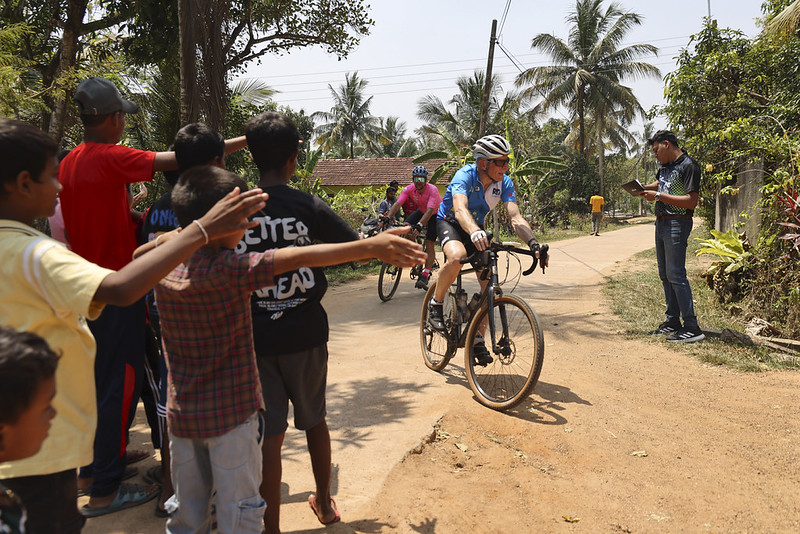
Road transfers are part of the reality. The best off-road sections are often linked by short stretches of tarmac or concrete lane, and this is no bad thing. These transitions reveal everyday Sri Lanka – schoolchildren walking home, tea pickers at work, roadside fruit stalls and small temples marking the edge of a village. On a mountain bike, the journey between trails is part of the experience rather than dead mileage.
How hard is the riding?
The Hill Country can be as demanding as you make it. The challenge generally comes from accumulated climbing, surface changes, humidity at lower elevations and the occasional rough descent rather than relentlessly technical terrain.
A fit rider should be comfortable with days of 40 to 70 kilometres and 800 to 1,500 metres of ascent, depending on the route. Bigger point-to-point days are possible, particularly when a support vehicle carries luggage and provides water, snacks and mechanical assistance. That support transforms the experience: riders can commit to a long ridge traverse or a remote descent without worrying about hauling kit or finding transport at the end.
Technical ability matters most after rain. Wet red clay can be slippery, leaf-covered forest sections can conceal rocks, and drainage channels may create abrupt obstacles. Riders who are relaxed on loose ground and able to manage sustained braking on steep descents will get the most from the region. A dropper post is useful, though not essential; reliable brakes and grippy tyres matter more.
When to ride Sri Lanka’s Hill Country
Weather is the main planning variable. Sri Lanka’s monsoon pattern is complex because different parts of the island receive rain at different times. The central highlands can be ridden year-round, but conditions and route choices change substantially with the seasons.
For many riders, January to March offers a favourable mix of cooler temperatures and relatively dependable conditions in much of the Hill Country. July to September can also work well, particularly for highland-focused itineraries, though local rain remains possible. The inter-monsoon months may bring dramatic skies and lush trails, but also heavier showers, softer surfaces and reduced visibility on exposed ridges.
A little rain should not put you off. It is part of the Hill Country’s appeal and keeps the landscape intensely green. It does mean packing properly: a lightweight waterproof, warm layer for high starts, full-finger gloves and dry clothing for the vehicle are sensible additions. The temperature can move from cool and misty to humid and hot on a long descent.
Choosing the right bike and kit
A hardtail with a suspension fork in the 100- to 130mm range is the most versatile choice for a classic Hill Country mountain bike trip. It handles rocky estate descents while remaining efficient on mixed-surface climbs. A short-travel full-suspension bike brings extra comfort and confidence on rougher terrain, especially if you favour technical descending.
Gravel bikes work brilliantly on selected routes, but tyre clearance and gearing are non-negotiable. Aim for wide, durable tyres and low gears for steep plantation climbs. A pure race-gravel set-up with narrow tyres may prove frustrating once the track gets rough or wet.
Bring comfortable riding kit for variable temperatures, strong sun protection, quality padded shorts and a hydration pack or large bottles. Local food stops are a highlight, but they should complement rather than replace a sensible hydration plan. Tubeless tyres, spare sealant, a tyre plug kit and a reliable rear mech are worth their weight here. The terrain is wonderfully varied, but it can be unforgiving on poorly prepared equipment.
Why guided support changes the experience
Sri Lanka is welcoming, compact and richly rewarding, but it is not always straightforward to navigate by GPS alone. Estate access can change, storms can affect tracks, and the best connecting lanes are often the ones that do not look obvious on a mapping app. Add busy main roads in some areas and a language barrier outside tourist centres, and local knowledge becomes a genuine asset rather than a luxury.
Expertly crafted guided journeys also allow riders to focus on the good stuff: the next climb, the next tea stop, the view breaking through the mist. Luggage moves ahead, a mechanic can resolve a problem before it ends a day, and accommodation is chosen to match the route rather than dictate it. That is particularly valuable on a long-haul cycling holiday, where each day should feel like a ride worth travelling for.
Multi Terrain Biking has spent years refining routes across Sri Lanka, combining demanding highland riding with the kind of logistical support that keeps an ambitious trip stress-free. The result is not a sanitised version of the country. It is a more confident way to access its best terrain.
The real reward is beyond the trail
What separates the Hill Country from many mountain bike destinations is what surrounds the riding. You may finish a muddy descent with a curry cooked to order, wake in a heritage bungalow overlooking tea fields, or share a section of track with farmers heading home. The rides are challenging enough to feel significant, but they are never detached from the place you are travelling through.
For riders prepared to trade bike-park polish for wild variety, warm hospitality and deeply immersive days in the saddle, Sri Lanka’s Hill Country is more than good for mountain biking. Choose the right season, bring a capable bike and give yourself enough time for the highlands to unfold at their own pace.