
UPDATED – 28th October 2021
When travelling to a new country, it’s always best to be pre informed with as much information as possible to ensure your time there is as enjoyable as possible.
We’ve put together some information for visitors travelling to Nepal, from arriving at the airport to heading off into the mountains that should help make your Himalayan adventure the ultimate experience.

Nepal
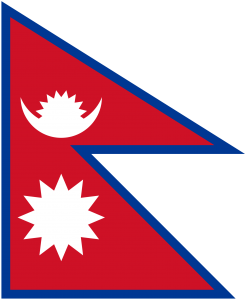
Nepal is a landlocked country located between India and China. It has a surface area of 143,000km2, is home to the highest mountains of the world (8/10 of the world’s highest), most impressively is Mt. Everest at 8850m elevation. Nepal hosts its own calendar and is approximately 57 years and 8.5 months ahead of the Gregorian calendar (so when it is Oct/Nov 2019 in the Gregorian calendar it will be Mangsir 2076 in the Nepali calendar). Nepal’s national flag is the only flag that isn’t a square or rectangle.
Covid 19 conditions
The Government of Nepal still requires specific conditions of entry for international passengers. Those seeking to enter Nepal need to present certain documentation:
- a certificate showing a negative Reverse Transcription Polymerase Chain Reaction (RT-PCR) test, taken within 72 hours of flight of first departure
- a visa or prior approval document. If you are appropriately vaccinated, you can secure a visa on arrival
- a travel insurance document which covers health, immediate crisis, or rescue for the duration of your travel
- a hotel booking, or a guarantee of accommodation, that allows at least ten days’ quarantine in Nepal (if not vaccinated)
- Barcode generated from the online application of the Online International Travel Arrival Form. See ARMS-DIMS.
Like the Government of Nepal, many carriers now require valid COVID-19 negative PCR tests, taken within 72 hours or less of the flight, for international flights departing Nepal, as well as for some domestic flights. You should check with your carrier, and make appropriate arrangements.
A list of Government labs, private A category labs and private hospital based labs offering fit to fly PCR tests can be found here – PCR TESTS.
BIDH Labs have also come highly recommended for fit to fly PCR testing and have an outpost in Thamel.
* We strongly recommend checking if there have been any changes to the required documents / process before travelling.
Time Difference
Nepal standard time (NPT) is five and three quarters ahead of GMT (allowances should be made for summer-time changes).
Language
Nepali is the official language of Nepal and spoken by approximately 90% of the population, although there are many variations of this language based on regions, religion and caste. There are many other languages and about 30 major dialects. English is also widely spoken in tourist areas. Learning and using a few words such as hello (namaste), thank you (Dhanyabhad) and good night (Suveraatri), is much appreciated.
Safety and Crime
Levels of petty crime are far lower than in many other Asian countries and violent attacks against tourists are infrequent. As with any travel, it pays to be vigilant; exercise caution and common sense; never flash valuables or leave them unattended and open to temptation.
The most potentially hazardous encounter in Nepal is the traffic – vehicles are often driven in unexpected and dangerous ways, and so always be alert and exercise caution when crossing a road or cycling on a road.

Money
Nepal’s local currency is Nepalese Rupees (NPR) and it is a closed currency (meaning that you can only get it in Nepal).
If you are bringing your spending money from your home country it makes good sense to bring the majority in the form of traveller’s cheques or cash in either USD ($), GBP (£) or Euro (€) (USD is usually the preferred currency). There are many places to change money in Kathmandu and Pokhara. The largest amount of cash that you can bring into Nepal without declaring is $5,000 USD.
Alternatively, you can bring an ATM card and withdraw small amounts of money in the cities as and when you need it. Please be aware that not all ATM machines work, and that it is better to go in the morning as they are likely to have ran out of cash by the evening! You can also bring cash and change it to NPR in Kathmandu or Pokhara, the largest amount you can bring into Nepal without declaring it is $5000 USD.
Costs
* Generally, the higher the location – the higher the cost! A bottle of mineral water in Kathmandu can cost as little as 10 NPR, whereas at Thorong Phedi that will have risen to approx. 300 NPR. The same goes for food. A typical Nepali meal of Dal Bhat can be purchased in the capital for around 200 NPR but along the trails, the cost could be double or in some locations even triple that, with western style food having an even higher incremental cost.
Alcohol is relatively expensive, anywhere in Nepal. A 500ml bottle of locally brewed beer (Everest or Gorka) will cost you around 3-500 NPR at most popular locations in Kathmandu and could just about bankrupt you at Thorong Phedi!
Hotel accommodation in Kathmandu ranges from around $10 USD a night for something quite basic to over $200 USD a night a luxury hotel. Expect to pay $40 -$50 USD a night for a double room including breakfast at a mid-range hotel in Thamel.
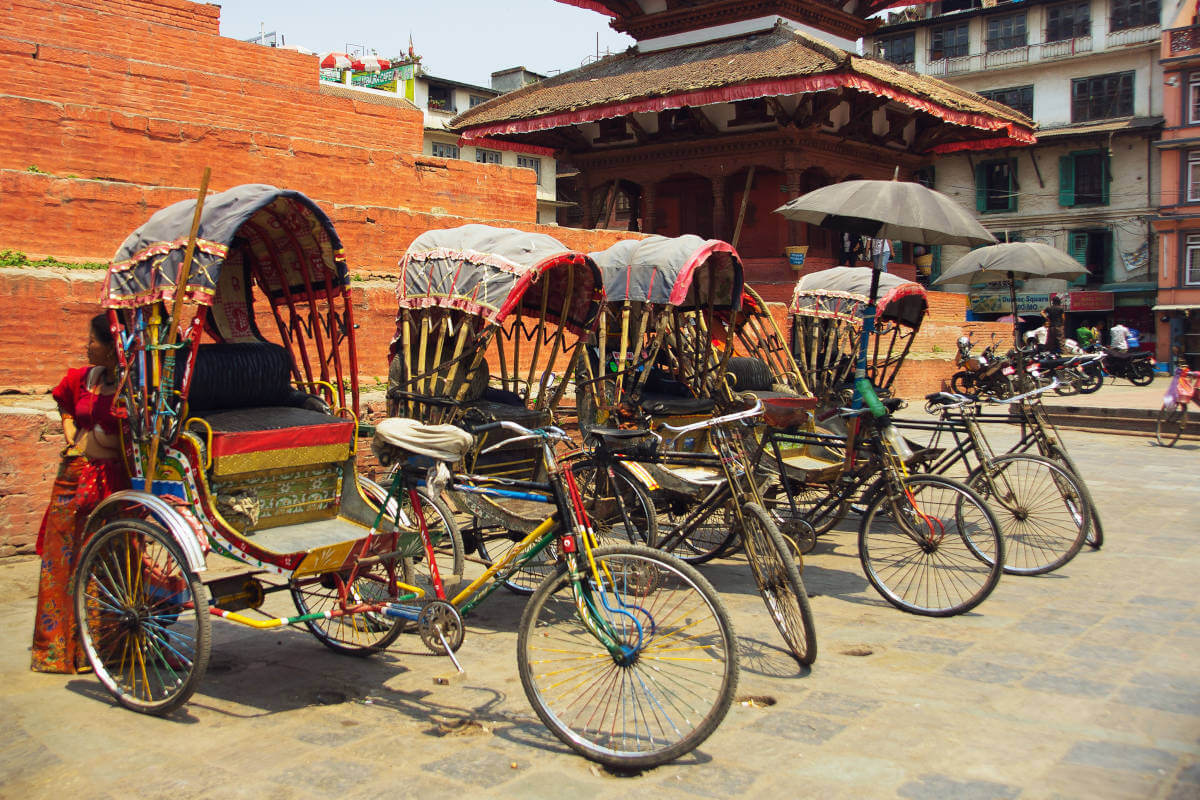
Taxi and rickshaw prices must be negotiated before departure. There is a new law now in Kathmandu, where licensed taxi drivers must wear a yellow jacket.

Tipping
Tipping in Nepal does help to reward and encourage good service. Tip in cash if paying by credit card and give directly to the person you wish to reward. In Nepal, especially outside of Kathmandu and Pokhara, wages are low, and the cost of living is rising, so a tip is a gesture that really does work. 5% is adequate for a restaurant, 200 NPR for porters and cleaners at the hotels.
Internet
When in Kathmandu and Pokhara most restaurants and hotels will have access to good quality Wi-Fi but this can fluctuate depending on how many people are using it and the connection. If you purchase a local sim card, usually, the internet works well and provides a reliable service in the cities. Please note, depending on sim card, this can be limited in once in the mountains.
* Once headed into the mountains internet connections can either be painfully slow or non-existent! If you decide to pay for wi-fi in the teahouses, please don’t be surprised if it is very slow or doesn’t work at all. This is the high Himalayas after all!
Electricity
The standard voltage is 230 V and the frequency is 50-60Hz. The standard Nepalese electrical outlet is a three-pronged triangle, but some have been retrofitted to accept US and European plugs. Simple adapters can be purchased inexpensively and since voltage can fluctuate, it is safer to bring a stabiliser if you are going to be using sensitive electronic equipment.
The electric is produced by hydro-electric dams and cannot always meet demand. Hotels and businesses often have battery back-up and noisy diesel generators for in case of power cuts (although power cuts are happening less over time).
* Most hotels and tea houses have a supply of electricity and sockets in the rooms but this can be somewhat sporadic and cannot be guaranteed, especially as we get higher into the mountains.
If there are no sockets in the rooms, then the tea houses will usually have a few in communal areas. There is usually a charge of around 100 NPR per hour for this service and an adapter will be required. It is better for riders and companions to charge their batteries on a rota system, and to bring a fully charged power bank, keeping this charged as much as able.
Toilets
Outside of Kathmandu and Pokhara, the ‘squat toilet’ is the norm, except in hotels and guesthouses geared towards tourists.
In tourist areas, you’ll find Western toilets and probably toilet paper. In general, put used toilet paper in the separate bin; don’t flush it down the toilet, as pipes and sewage systems cannot cope with this.
Adjacent to the squat toilet is a bucket and/or tap, which has two functions: flushing the toilet and cleaning the nether regions (with the left hand only) while still squatting.
* Most rural places don’t supply toilet paper, so always carry an emergency supply if you are not keen on the bucket/tap way. More rustic toilets in rural areas may consist of a few planks precariously positioned over a pit in the ground. Please be aware that we travel to rural and remote areas, which means that sometimes a western toilet isn’t available.
Religion
Nepal is known as a Hindu Kingdom, although it is an intricate tapestry of Hinduism, Buddhism, Christianity, Islam, Tantrism and others, demonstrating great religious tolerance and harmony. Traditions and festivals are prevalent, as are temples and stupas, which you cannot fail to see.

Etiquette
An all-purpose Nepali greeting is “Namaste”, uttered whilst keeping one’s own hands at chest height, palms together. When greeted in such a manner, it is polite to respond as such.
Handshaking is also an acceptable greeting, but never offer your hand to a monk.
Few Nepalese use cutlery, preferring to pick up food with their hands – do not be afraid to ask for cutlery. When passing items, eating, or shaking hands, always use the right hand. The left hand is traditionally the hand used when splashing yourself with water having used the toilet!
Public displays of physical affection should be avoided.
Nepali people will forgive many breaches of etiquette such as swimwear and eating habits. But always remember to remove shoes and headgear when entering temples as a sign of respect. Ladies should also cover shoulders and long skirts or trousers, in such places. Show respect by turning off mobile phones etc. and by avoiding inappropriate or loud conversation. Statues should not be touched or sat near or on, and pointing is considered very rude.
Local Food
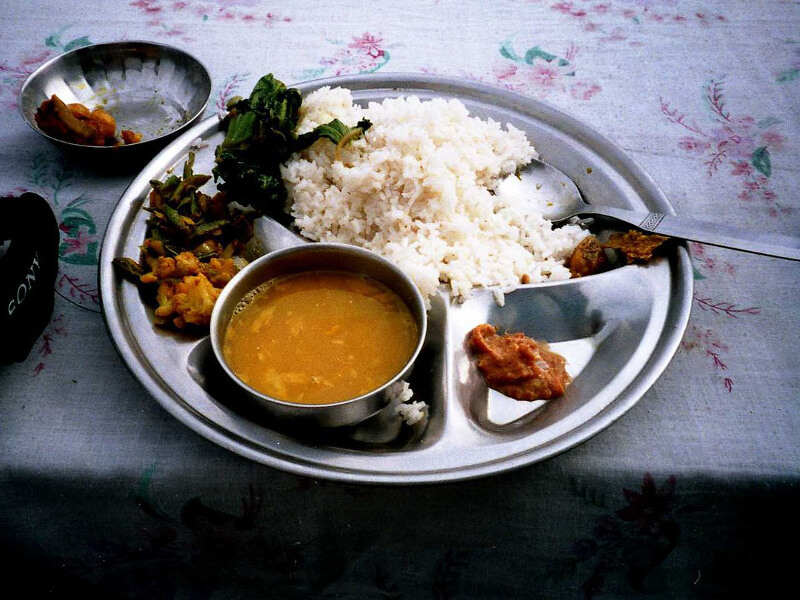
The staple diet of Nepal is Dal Bhat which consists of rice (Bhat), a cooked lentil soup (dal), spinach & chutney/pickles. There may also be served with salad, curd (a local type of yoghurt), pappads (poppadum’s) and a curry made of meat or vegetables. Generally speaking, Nepalis will eat this 2-3 times a day.
Other local food includes momos, which is a Tibetan dish that consists of a type of dumpling that contains either meat or veg and is served with a dip and Thukpa which is a clear hot soup usually containing meat and/or veg and noodles.
Local alcohol includes Raksi (a clear white home brewed spirit) and Thongba – a fermented millet seeds, served in a metal cup and straw that you top up with hot water.
Water
Tap water is not safe to drink, however bottled water is readily available, and most places now offer filtered water. If purchasing bottled water, make sure that the plastic wrapping is around the top as some places may just fill plastic bottles with normal tap water.
Plastic bottles, however, contribute immensely to Nepal’s pollution and waste problem. We would always advise modern filters and water purifying tablets that will produce water that is safe to drink – it will save you money and will help reduce the pollution in the country. If purchasing a filter for the first time, it is probably best to obtain it from your country of origin from a reputable source.
Passport Validity
Your passport should be valid for a minimum period of 6 months from the date of entry to Nepal.
Visas
Visas are required for most foreign travellers entering into Nepal. They can be arranged in advance at your nearest Nepali embassy. It is worth noting that some countries MUST have their visa prior to entry – so always double check with your local embassy before arranging your trip to Nepal.
If you are going to obtain a visa on arrival, the prices have marginally increased this year; a 15-day visa is $30 USD, a 30-day visa is $50 USD, or a 90-day visa is $125 USD. These have to be paid for in cash foreign currency (i.e. USD ($), AUS ($), Euro (€), GBP (£)).
*When you arrive in Tribhuvan airport you will have to fill in an arrival card, (if this hasn’t already been given to you on the aeroplane) please ensure that you have a pen handy.
You will then have to fill in an online tourist visa form which has to be done on the Kiosk, it is worth bringing passport photographs with you in case the kiosks aren’t working, and we will also need passport photos (x2) for your mountain permits. Alternatively the online tourist visa form can be completed online via this linkand is valid for 15 days, please ensure that you take the submission receipt with the barcode with you.
You will then head over to the ‘bank’ with your foreign currency cash and pay for the correct length visa.
Once you have all your documentation, proceed over to the immigration desk with your arrival card, tourist visa form, receipt for the fees paid and passport where you will pass through passport control and your visa will be issued. You will then head down to collect your baggage.
Tribhuvan International Airport, Kathmandu
The airport in Kathmandu can be very busy and ques can be long throughout, especially with the proposed airport works that will see the airport closed for 7 hours each day into December 2019.
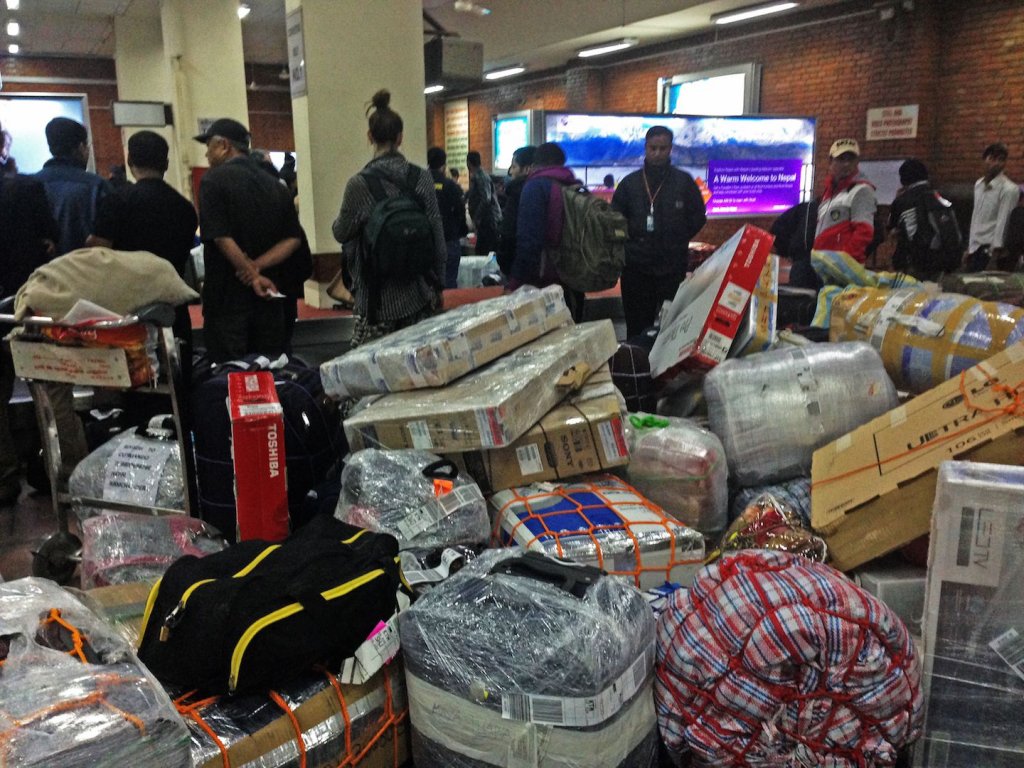
Once you have collected your visa and started towards the baggage hall, you will notice that it can be hectic and there is not always much indication of which belt your luggage is on. In the unlikely event that your luggage doesn’t turn up, there is an official desk dealing with these issues situated to the left-hand side (as your heading out) of the arrival / baggage claim hall. It is a good idea to have a photograph of your luggage so that it is easily identifiable if it should be delayed and/or lost.
* Please ensure that you retain your luggage tags as these need to be checked on your exit to make sure that you have the correct luggage.
Contrary to what you might be told, trolleys are free, but if you enlist the help of an airport porter then they will expect to be paid for their services. It is also common for porters to try and ‘help’ you with their bags after exiting the airport. Again, expect to have to pay for this should you enlist their help.
Taxis into Kathmandu can be booked at the desk situated in the corridor exiting the airport or, if you have pre-booked a hotel, many have mini buses waiting for you outside the airport terminal but please check this at the time of booking – it is always best to check with the guesthouse that they will be meeting your flight and to ensure that you find the correct driver.
Finally, don’t let all this information overwhelm you or put you off a visit to Nepal. It is an amazing country that we know you will fall in love with, and our Mountain Bike Worldwide trip advisors are always on hand to answer any questions you may have before, during or even after your holiday.